Democratizing Product Placement: How Vertical Micro-Series Are Financing the Next Generation of Content
Feb 20, 2026
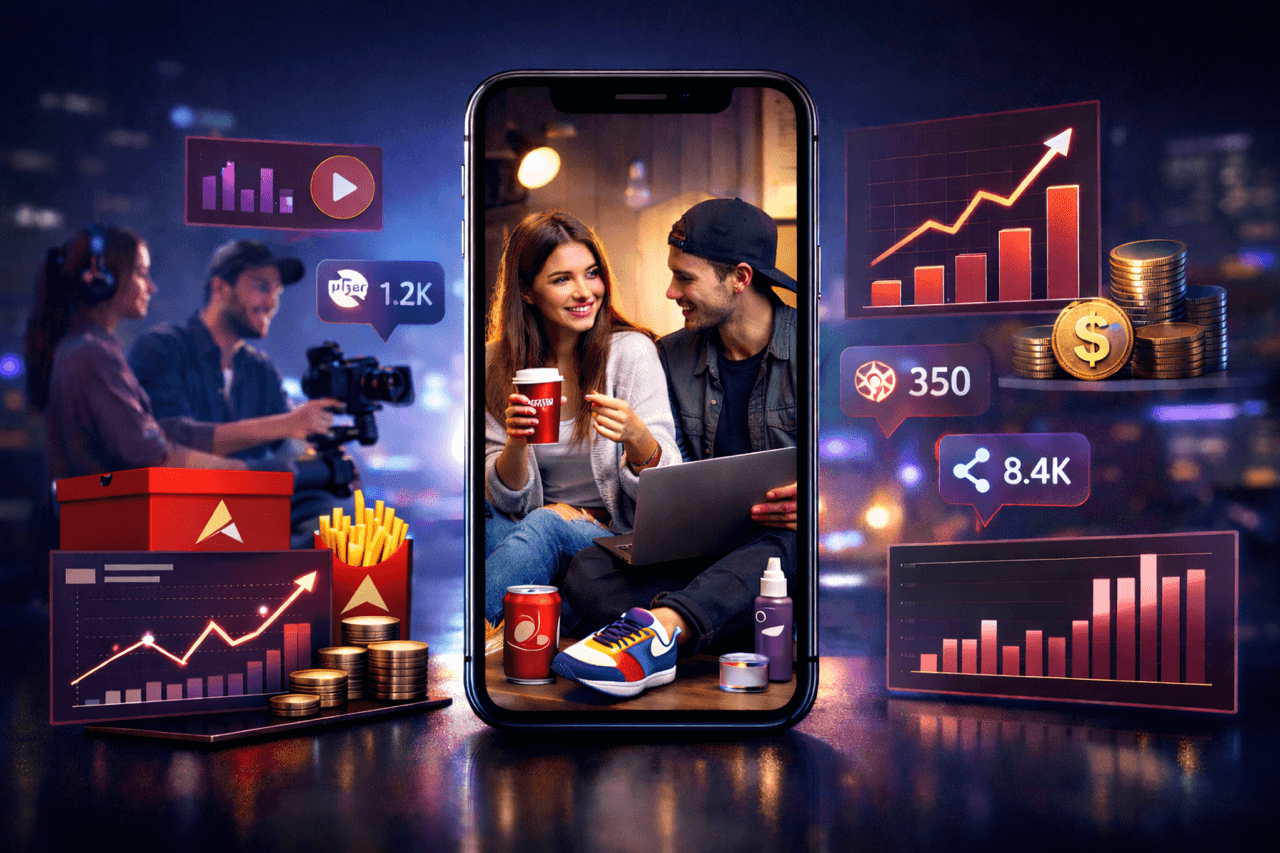
The average Hollywood film is announced 871 days before it reaches theaters. That’s nearly two and a half years from the moment a brand might negotiate a placement deal to the moment anyone sees the product on screen.
Maybelline recently went from initial idea to a finished five-part vertical micro-series — starring Lacey Chabert and Dustin Milligan, produced by Ryan Reynolds’ Maximum Effort — in under six weeks.
871 days versus 42. That’s not a rounding error. It’s a structural shift.
Product placement is a $30 billion global market growing at double digits for four years. But it has always operated like a private members’ club. Agency retainers run $40,000 to $300,000 per year just for access — before any deal is struck. When Heineken wanted seven seconds of screen time in Skyfall, the price tag was reportedly $45 million. These aren’t marketing budgets. They’re small acquisitions.
And cost is only the first gate. The second is time. Hollywood production cycles run one to two years from production to premiere. A brand manager planning a Q3 launch can’t build strategy around a film that might release in 18 months — or get shelved entirely. Placement timelines are misaligned with quarterly targets, seasonal campaigns, and SKU windows. The third barrier is access itself: getting in historically required relationships with prop masters, production designers, and showrunners. Even then, the studio controls the final edit. Your product might get a hero shot or end up on a cutting room floor.
Vertical micro-series — including microdramas and other short-form serialized formats — dismantle all three barriers. An entire series — 60 to 100 episodes — can be produced for $50,000 to $300,000. Shoots take 5 to 10 days. A full branded campaign can be live within weeks. And entry doesn’t require Hollywood connections: when platforms like Taobao, Pinduoduo, and Meituan embed vertical storytelling sections directly inside their shopping apps — with product placement built into episodes and clickable purchase links on screen — the process starts to look like managed media buying, not Hollywood diplomacy.
Another shift is technological. Advances in AI-assisted production and post-production are making product integration increasingly flexible — closer to dynamic media than fixed placement. Brands can test variations, swap products across markets, or adapt integrations over time rather than committing to a single locked edit. As tooling improves, placement starts to resemble performance marketing: iterative, measurable, and responsive rather than static.
The scale is already significant. According to Variety, Media Partners Asia projects the global vertical micro-series market will reach $26 billion by 2030. In China, short-form drama revenue surpassed the national box office for the first time in 2024, hitting $7 billion.
So far, the format has been dominated by romance and drama, with a core audience skewing female — which is why most brand integrations today sit in beauty, skincare, and lifestyle categories. But as the ecosystem expands into genres like fantasy, thriller, gaming-adjacent narratives, and male-skewed storytelling, the advertiser base expands with it. New genres don’t just diversify content — they unlock entirely new product categories, from consumer electronics to automotive and sports brands. The evolution of vertical micro-series is not just a format shift; it’s a demand expansion for brand participation.
What makes this a two-sided opportunity is that micro-series platforms have their own problem: they need constant financing to keep producing content. The economics resemble a venture portfolio — platforms run dozens of bets simultaneously because only about 2% of series cross 100 million views. More content means more chances of a hit. But production never stops, and funding is always the constraint. Co-financing from brands solves this: brands get affordable, fast placement; platforms get capital to scale their libraries. Each side fills the other’s gap.
The playbook already exists. Starbucks launched a six-episode micro-series on Douyin where a barista time-travels to ancient China and opens a “Starbucks Inn,” releasing one episode per day. Chinese cosmetics brand Kans invested in five mini-drama series on Douyin and saw its GMV surge 374% year-over-year to 3.34 billion yuan ($463 million), according to the company’s HKEX-filed annual report — ranking number one in Douyin’s beauty category for over a year and quadrupling L’Oréal’s performance on the platform. KFC’s 13-episode series about a reincarnated empress accumulated over 100 million views on Douyin, with weekend promotions woven directly into the episodes.
This is also where placement begins to blur into embedded commerce. Vertical series are increasingly built with native shopping layers — clickable products, in-episode offers, and frictionless checkout — turning storytelling into a direct conversion channel rather than just an awareness play.
In the U.S., the format is arriving through legacy players. Maybelline’s “Maybe This Christmas” was distributed across social platforms and ReelShort, with the product integrated into plot mechanics rather than placed in the background. And then there’s P&G. In the 1930s, Procter & Gamble began sponsoring serialized radio dramas to advertise soap products like Oxydol to housewives — a strategy so successful that the entire genre became known as “soap operas.” Nearly a century later, P&G has come full circle: its 50-episode “Golden Pear Affair” is the first American branded microsoap — the soap opera reinvented for the vertical screen.
There’s a deeper reason placement works better here. Meta-analytic research shows that while prominent placement boosts recall, its impact on attitude and purchase intent depends on narrative fit. Just being visible isn’t enough — the product needs a role in the story. Vertical micro-series are built on dense dramaturgy and constant cliffhangers, making it natural to give a product a functional role: solving a problem, triggering a plot twist, becoming part of a character’s ritual. And because the format is serial, that association accumulates across five, ten, or twenty episodes. The difference between a logo on a shelf and a product woven into someone’s world.
Product placement has long been one of marketing’s most powerful — and most exclusive — tools. Vertical micro-series change the equation: faster, cheaper, programmable, and increasingly commerce-native. What began as a content format is quickly becoming an infrastructure layer connecting brands, audiences, and financing for the next generation of entertainment. A third of marketers already advertise on short drama apps such as ReelShort, Douyin, DramaBox and others. The brands that move now get to shape a channel that’s still wide open. The ones that wait will be buying inventory at premium prices once the rest of the market catches up.