Beyond the Ride: Where We See the Next Opportunity in Micromobility
Sep 17, 2026
The European micromobility market has entered a new phase.
The ride layer is consolidating and maturing. Lime listed on Nasdaq in July 2026. Voi reported positive adjusted EBIT in 2025, Dott was adjusted-EBITDA profitable, and Bolt recorded its first group net profit. In regulated shared markets, city tenders increasingly determine which operators can deploy vehicles and at what scale.
But while the ride has matured, the infrastructure around each vehicle has not.
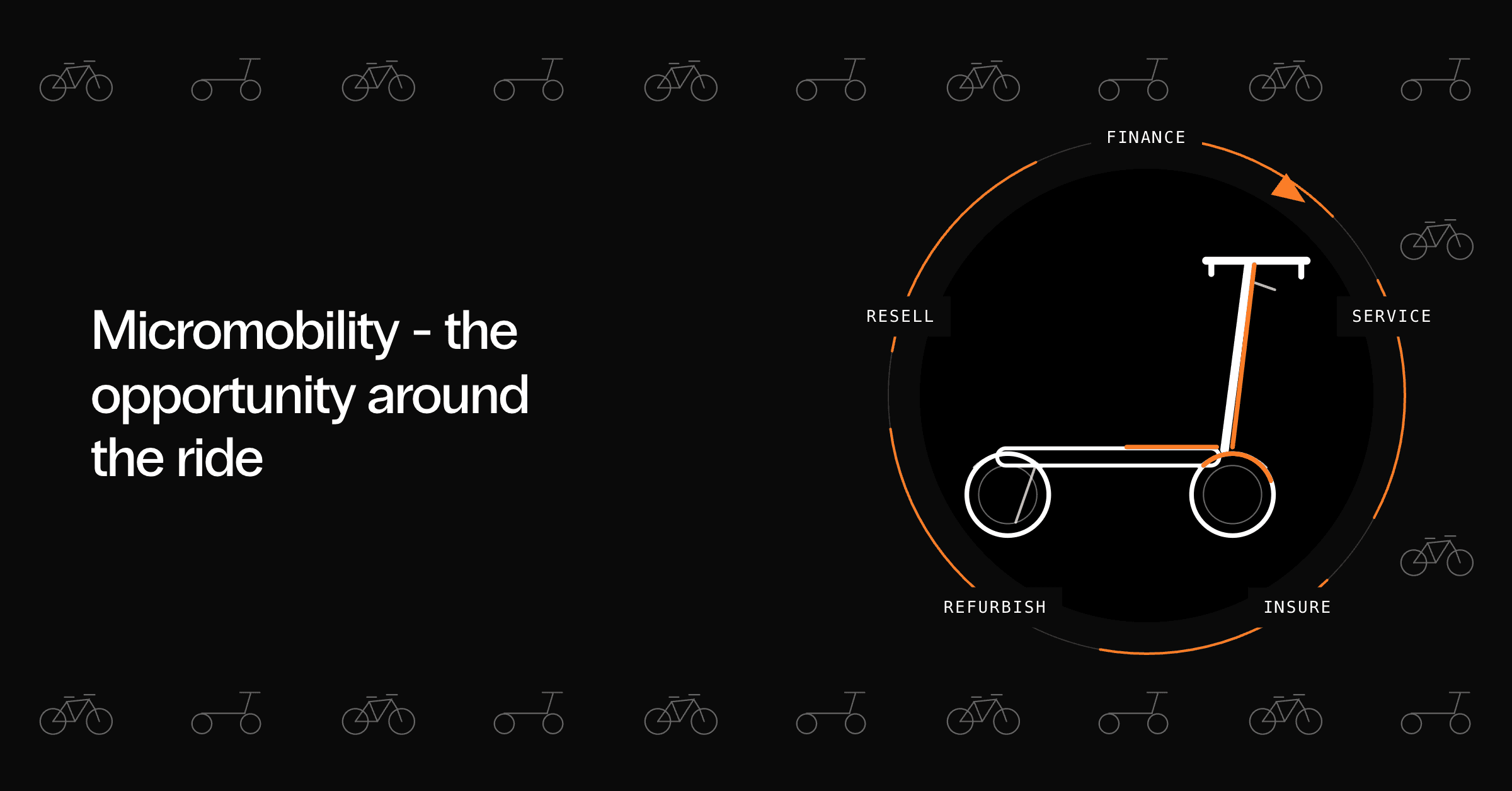
Every bike and e-bike needs to be financed, insured and serviced in use, inspected at return, refurbished and resold. In its second life, the same asset can enter the financing and insurance cycle again.
One asset, five monetisations.
That lifecycle, rather than the ride itself, is where we see an increasingly compelling opportunity.
Venture capital matured out of the ride. The revenue did not.
European mobility VC fell to $4.8 billion in 2025, down 27% and marking a fifth consecutive annual decline. This happened while European venture investment overall grew 18%.
More importantly, the composition of capital has changed. Debt, private equity and project finance now account for more than half of private investment in European mobility. Capital is increasingly being deployed against assets and cash flows rather than growth stories alone.
Meanwhile, the revenue pools around the asset remain substantial.
European bicycle and e-bike sales reached €17.4 billion in 2025. Germany's company-bike leasing market generated €2.8 billion from a fleet of 2.2 million bikes, while only around 11% of eligible employees currently participate.
Servicing tells a similar story. French bicycle workshop revenue reached €128 million in 2025, up 13% year on year across 6.3 million interventions. Interventions have increased 53% since 2019, even as new-bike sales have contracted.
The installed base keeps creating economic activity long after the initial bike sale.
The ride layer is supply-capped, not demand-saturated
European shared mobility fleets contracted by 3% in 2025, yet trips increased 16% and end-user revenue grew 9%. The market generated 709 million trips and €1.45 billion of end-user revenue from 848,000 vehicles.
The constraint is increasingly supply rather than demand. In regulated markets, fleet size is allocated through permits and tenders, meaning operator growth is often won through procurement rather than simply through consumer acquisition.
At the same time, the B2B infrastructure around those vehicles works across ownership models. Servicing, financing, insurance and recommerce can serve privately owned, leased and shared vehicles alike.
This changes where we look for value.
Our research screened eight segments across the micromobility lifecycle. Four currently meet our investment filter: fleet servicing and aftersales, end-of-lease processing and recommerce, leasing-adjacent B2B infrastructure, and selectively, specialist financing and asset-backed origination.
Tyred: our first investment against the thesis
Our first investment against this thesis is Tyred, whose £2.5 million seed round we led in July 2026 alongside Ada Ventures.
Tyred started with one of cycling's least glamorous but most essential problems: keeping bikes on the road.
But the opportunity extends beyond repair.
By combining physical servicing with technology and data, businesses in this layer can build a relationship with the asset throughout its life, from maintenance and insurance to diagnostics, financing and ultimately resale.
That is the broader thesis behind our investment.
From rides to assets
The first wave of micromobility focused on the transaction: getting someone from A to B.
We believe the next opportunity sits around the asset itself.
Europe has a large and growing installed base of bikes and e-bikes. Every vehicle entering that base creates potential recurring demand for servicing, insurance, financing and second-life infrastructure. As the market matures, these layers become increasingly important.
The ride is only one transaction. The asset has a lifecycle.
Our new State of Micromobility 2026 report explores that lifecycle in depth, including where capital is moving, how the European market is consolidating, the eight segments we screened, and where Raw Ventures sees opportunities for deployment.
Download the full State of Micromobility 2026 report to explore the data and our complete investment thesis.